
If at any point you have decided to play blackjack in a well-lit and crowded casino or through a mobile game at your home, you would have experienced the excitement of a new deal. However, before you confidently perform the “hit” or “stand” moves, you need to be good at the math part. Blackjack is not only a game where you rely on the roll of the dice, but it is also a game where you have to know what the exact numbers and probabilities are. To help you turn the tables on the dealer, we have listed all the necessary details about card values in blackjack. Once you give it a read, you will be able to decide on your “hand” immediately and also take the correct action every time.
Standard Blackjack Card Point Values
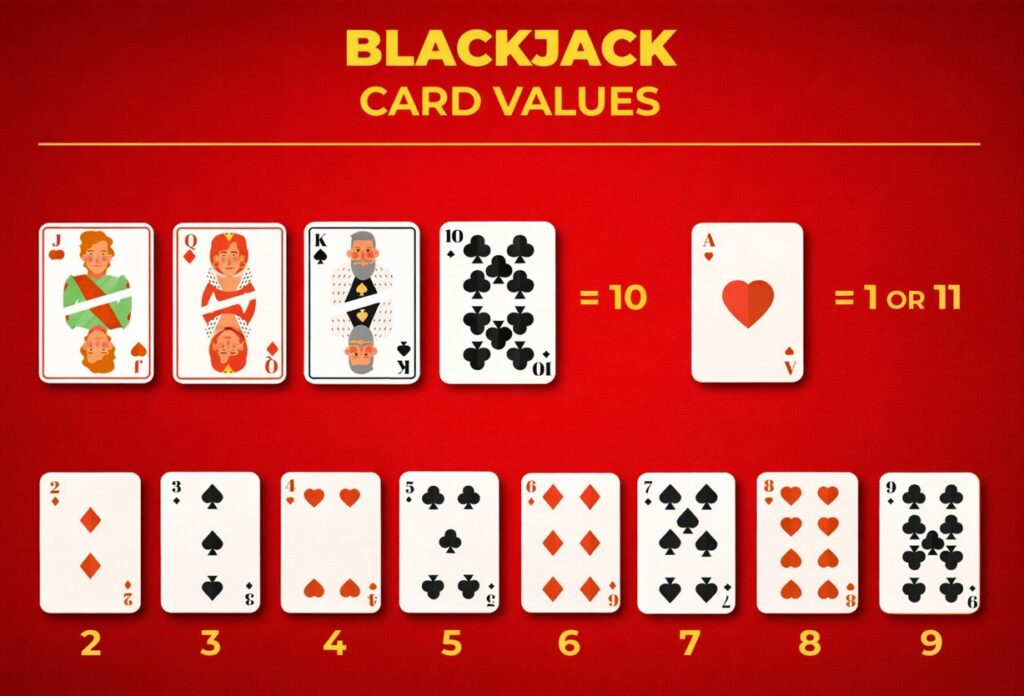
In blackjack, the suit of a card (Hearts, Diamonds, Clubs, or Spades) does not matter at all. The only thing that counts is the point value that each card carries. Most cards are quite simple, but a few “special” cards are the real starting points of the strategy. Let us first present a simple table that displays how each card is valued in blackjack.
| Card Type | Value | Notes |
|---|---|---|
| 2 through 10 | Face Value | A 5 is worth 5, a 9 is worth 9, and so on. |
| Jack, Queen, King | 10 | Often called “face cards” or “paint”. |
| Ace | 1 or 11 | The most powerful and flexible card in the deck. |
The Power of the Face Card
You should recognize that 10s, Jacks, Queens, and Kings each have a value of 10. As there are four of these for each suit, 10-value cards are the most abundant cards in the deck. Therefore, many beginner strategies recommend that you always “assume the dealer’s hidden card is a 10” as it is statistically the most probable situation.
The Ace: Flexible Assets of Blackjack
The Ace is the one and only card in the entire deck that has two identities. It can be 1 or 11 – whichever can make your hand stronger. This adaptability results in two separate kinds of hands: Soft and Hard.
Understanding Soft Hands
Anything with an Ace counted as 11 in the hand is referred to as a “soft” hand. The term “soft” comes from the fact that you can’t bust even if you take another card. For instance, if you pick up a large card that alone puts you over 21, then the Ace merely changes its value to 1 to let you continue playing.
- Sample: Your cards are Ace and 6. This is a Soft 17.
- The action: Should you hit and get a 10, your total will be 17 (1+6+10), not 27. You haven’t busted!
Understanding Hard Hands
A “hard” hand is one without an Ace or with an Ace counted as 1 only, to ensure the total doesn’t exceed 21. Hard hands are definitely more dangerous since a single hit may cause the player to bust.
- Example: You hold a 10 and a 7. So, Hard 17 are your cards.
- The Move: The moment you choose to hit, if the next card adds up to 5 or more, you’d bust.
Beyond the Basics: Hand Totals and “The Natural”
Although aiming for 21 is the general idea, the real winning hand is a “Natural 21”, or as most people call it, Blackjack.
- What exactly is a Blackjack?: It is a two-card hand with one card being an Ace (count as 11) and the other card being any 10-value card (10 J Q, or K).
- Here is the reason: A regular win normally pays 1:1, but a Blackjack usually pays 3:2 (meaning that a bet of $10 will win you $15).
How to Calculate Your Total Like a Pro
Counting the value of your hand should be really easy for you. Listed below are some of the typical situations with their hand values that you will be able to count in blackjack:
- The “Picture” Pair: King + Queen = 20 points (Never split these cards! You are in a very strong position already.)
- The Low Starter: 2 + 3 = 5 (Depending on the dealer’s card, you can either hit or double down)
- The Tricky 16: 9 + 7 = 16 (By the numbers, this is the worst blackjack hand).
Strategy Cheat Sheet for Blackjack: Values in Action
Knowing the values is step one. Knowing how to use them against the dealer is step two. Use this quick-reference guide for your next session:
- Always Split Aces and 8s: One Ace gives you one chance at a Blackjack. Two Aces give you two chances. Two 8s (Hard 16) is a losing hand; splitting gives you two chances to start fresh with 8s.
- Never Split 10s or 5s: A pair of 10s is a 20. Don’t break up a great hand. If you have two 5s, that’s 10; better double down to 20 or 21.
- Stand on Hard 17 or Higher: The chance of going over is too much to justify a hit.
- Double Down on 11: With 10-value cards being so common, you are quite likely to reach 21.




Does the suit of the card matter in blackjack?
No. Unlike in poker, the suit of the cards (spades, hearts, diamonds, clubs) does not affect the game result or the card value. Only the number one, the card, or its rank (J, Q, K, A) is important.
What happens if the dealer and I have the same hand value?
This is referred to as a “Push”. It basically means a draw. You don’t get any winnings, but you also don’t lose your wager – your chips remain on the table for the next game.
Can I count an Ace as both 1 and 11 in the same hand?
Not simultaneously. The Ace is adaptable; however, it can only count as one value when totaling your hand. Nevertheless, it can “flip” from 11 to 1 by adding more cards.
Why are 10, Jack, Queen, and King all worth the same?
This is the usual rule in the game for the purpose of providing enough high-value cards to make the 21-point goal difficult, and at the same time maintain the house edge balanced.